
Safe driving isn't just about following rules. It's about building the right mindset behind the wheel — a mindset that keeps you, your passengers, and everyone else on the road as safe as possible. The 5 C's of safe driving are a useful framework for understanding what that mindset looks like in practice.
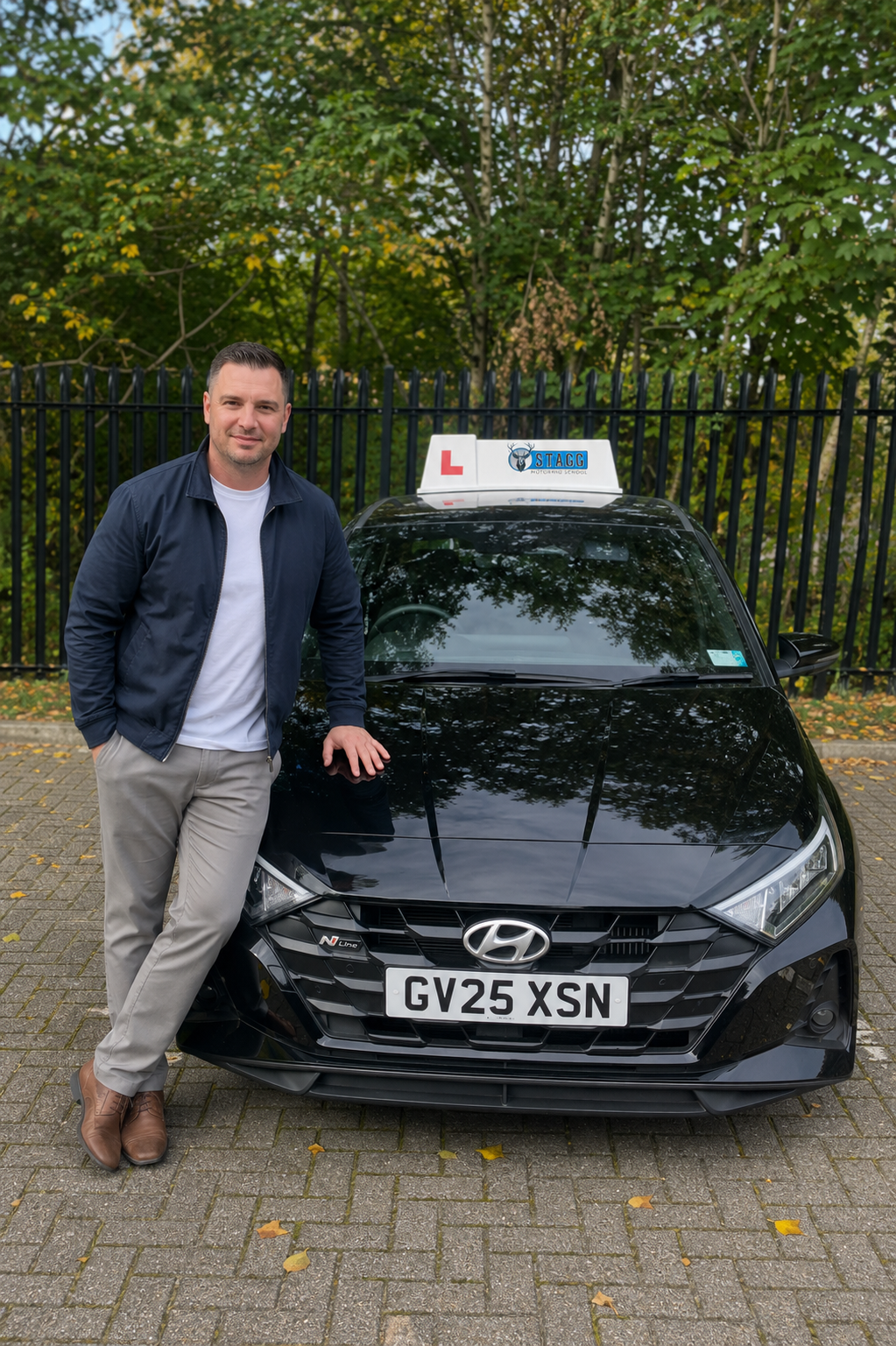
As an ADI-registered instructor with 18 years of teaching experience in Crawley and Horsham, Dan Stagg builds every lesson around these principles — not as abstract concepts, but as practical habits that learners carry with them long after they've passed their test.
Concentration · Consideration · Care · Caution · Common Sense
1. Concentration
Concentration means giving your full attention to the task of driving — every minute you're behind the wheel. That sounds obvious, but it's harder than it sounds. Modern life is full of distractions: mobile phones, conversation, the radio, passengers, tiredness, and a wandering mind.
According to road safety data published by the Department for Transport, driver distraction is a contributing factor in a significant proportion of road accidents. Even a momentary lapse — glancing at a phone for two seconds at 30mph — means you've travelled 27 metres without watching the road.
What concentration looks like in practice:
- Eyes scanning ahead, not fixed on the bonnet or the car in front
- Constant mirror checks — approximately every 8-12 seconds in normal driving
- No mobile phone use — ever, including at junctions or traffic lights
- Adjusting the radio or sat nav only when stationary
- Avoiding lessons or long drives when significantly tired
For learners specifically, concentration is stretched because you're managing multiple tasks simultaneously — clutch control, gear selection, observation, and signalling — while still learning how each one works. This is precisely why lesson progression matters: each skill needs to become automatic before the next one is added.
"In 18 years I've only ever seen one type of driver make consistent mistakes — the one who thinks they already know enough to stop paying attention. Concentration isn't something you turn on for the tricky bits. It's constant."
2. Consideration
Consideration means thinking about how your driving affects others — pedestrians, cyclists, motorcyclists, other drivers, and passengers. It's the difference between a driver who technically follows every rule and a driver who other road users actually feel safe around.
Considerate driving includes:
- Giving cyclists adequate space when overtaking (the Highway Code recommends at least 1.5 metres)
- Not tailgating — maintaining a safe following distance in all conditions
- Letting pedestrians cross when they're waiting at an unmarked crossing
- Flashing headlights only to warn of your presence — not to signal irritation
- Giving way where appropriate even when you technically have priority
- Not using your horn aggressively
Consideration also means thinking about your passengers. If someone in your car is nervous, adjusting your speed or tone of driving to reassure them isn't weakness — it's good driving.
The Highway Code was updated in 2022 to clarify the hierarchy of road users — pedestrians and cyclists are at the top, and drivers have a greater responsibility to give way to more vulnerable road users than vice versa. This isn't a new principle; it's the formal expression of what consideration has always meant.
3. Care
Care refers to the physical precision of your driving — smooth inputs, controlled acceleration and braking, and handling the vehicle with gentleness. A car that's driven with care feels settled; a car that's driven carelessly feels unpredictable.
Caring driving looks like:
- Smooth, progressive braking — not last-second slamming
- Gradual acceleration — not harsh throttle from a standstill
- Steering inputs that are deliberate and controlled, not snatchy
- Checking the vehicle before setting off — lights, mirrors, tyre pressure
- Not overloading the car or loading it in a way that affects handling
Care is also about vehicle maintenance. A driver who cares about safe driving keeps their car properly serviced, checks tyres regularly, and doesn't ignore warning lights. This is especially relevant for new drivers who may be driving older vehicles.
On the driving test, care is reflected in smooth control — examiners notice jerky steering, heavy braking, and harsh gear changes. A driver who handles the car gently is demonstrating mastery, not timidity.
4. Caution
Caution means anticipating hazards before they become problems, and adjusting your speed and position accordingly. It's the forward-thinking element of safe driving — reading the road rather than just reacting to what's immediately in front of you.
The hazard perception element of the theory test specifically assesses this ability. Learners who score highly in hazard perception are demonstrably safer drivers.
Cautious driving in practice:
- Slowing before a bend rather than braking through it
- Giving extra space to lorries, buses, and vehicles that may swing wide
- Anticipating that a parked car may open its door
- Slowing near schools and pedestrian areas in case of children
- Adjusting speed in rain, ice, fog, or low sun visibility
- Extending following distance in wet or icy conditions (the two-second rule becomes a four-second rule in rain)
In Crawley, caution is particularly important at complex junctions like Hazlewick roundabouts, where traffic approaches from multiple directions at speed. Learners who approach these with appropriate caution — reading the lanes, checking mirrors early, slowing to match the flow — pass through safely. Those who arrive at speed and hope for the best accumulate faults.
When you see a developing hazard — a pedestrian stepping off the kerb, a car pulling out of a side road — your response should begin before the hazard is fully realised. Early recognition is what separates experienced drivers from nervous ones.
5. Common Sense
Common sense is the fifth C and the most difficult to teach directly — because it's the application of all the other four principles to real-world situations that don't fit neatly into any rule.
Common sense driving means:
- Recognising when a situation requires extra caution even if no sign tells you so
- Deciding not to overtake even though the road appears clear, because something feels uncertain
- Pulling over safely when you're tired instead of pressing on
- Not following a sat nav instruction when road conditions make it unsafe
- Knowing that having right of way doesn't mean it's always wise to assert it
Common sense is largely developed through experience — which is why new drivers are statistically more at risk in their first year after passing than at any other time. Dan recommends that new drivers consider Pass Plus training after their test, which specifically develops experience in motorway driving, night driving, all-weather driving, and rural roads.
How the 5 C's relate to the driving test
The 5 C's aren't tested by name, but every element of the practical driving test maps directly onto them. When an examiner marks a fault for ineffective observation at a junction, they're marking a failure of concentration and caution. When they mark a fault for inappropriate speed, they're noting a failure of care and common sense.
Understanding the 5 C's helps learners see the test not as a set of arbitrary boxes to tick, but as a genuine assessment of whether they're safe to drive alone on UK roads. That perspective change — from "passing the test" to "becoming a safe driver" — is one of the most valuable shifts a learner can make.
For more on what the test is actually assessing, read our guide on the most common driving test fails or our article on what counts as an instant fail.
The 5 C's beyond the test
One of the things Dan is most proud of as an instructor is that his pupils don't just pass their test — they become good drivers. The 5 C's are a useful reminder of the standard to aim for throughout a lifetime of driving, not just in the 40 minutes of a practical test.
New drivers face their highest statistical risk in the 12 months following their test. The DfT and road safety organisations consistently find that this risk is greatest at night, with peer passengers, and in unfamiliar environments. The 5 C's remain just as relevant — perhaps more so — once the examiner is no longer in the car.
Frequently asked questions
What are the 5 C's of safe driving?
Concentration, Consideration, Care, Caution, and Common Sense. Together they describe a mindset of attentive, thoughtful, and responsible driving — one that keeps everyone on the road safer.
Are the 5 C's tested in the driving test?
Not by name, but every fault an examiner can record maps to one or more of these principles. Understanding the 5 C's gives learners a framework for understanding what the test is actually measuring.
What is the most important C in safe driving?
All five are important, but Concentration is the foundation. Without sustained attention, the other four are impossible to apply consistently. Distracted driving — including mobile phone use — is one of the most dangerous behaviours on UK roads.
How do I improve hazard perception?
Practise the DVSA hazard perception clips, drive with commentary (talking through what you're seeing and anticipating), and choose an instructor who teaches in varied road conditions — not just quiet residential streets.