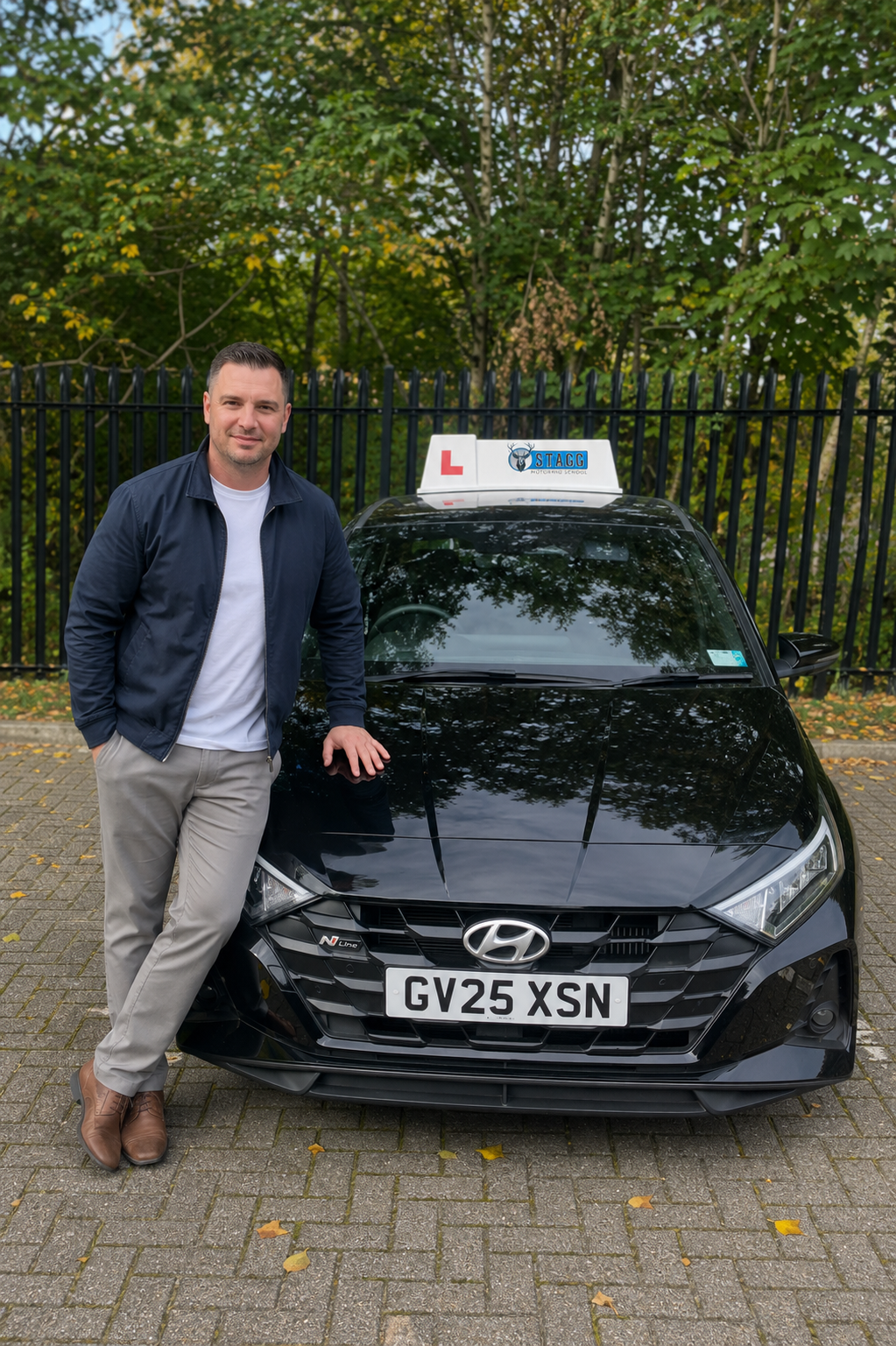
Passing your driving test first time is absolutely achievable — but it doesn't happen by accident. It takes the right preparation, the right instructor, and a clear understanding of what examiners are actually looking for. In this guide, Dan Stagg — ADI-registered instructor and founder of Stagg Motoring School — shares the strategies that have helped learners pass in Crawley and Horsham for over 18 years.
"Crawley's pass rate is 36%. That's not a reason to panic — it's a reason to prepare properly. The roads here are genuinely challenging: complex roundabouts, dual carriageways, rural stretches. If you know them, the test is manageable. If you don't, it's full of surprises."
1. Choose the right instructor — not just any instructor
Your instructor is the single biggest factor in whether you pass first time. A good instructor doesn't just sit in the passenger seat telling you what to do — they teach you to drive safely and independently, then structure lessons specifically around the roads you'll face on test day.
When choosing, look for an ADI-registered instructor on the DVSA's official register. The ADI qualification covers theory, driving ability, and teaching methods — all three parts must be passed. It's the highest level of driving instructor certification in the UK.
Beyond qualifications, ask whether your instructor:
- Knows the local test routes — not just the area in general
- Uses a structured lesson progression (not just "let's go for a drive")
- Will be honest about when you're ready to test — not rush you to fill an appointment
- Has experience with learners like you (nervous, neurodiverse, returning driver)
At Stagg Motoring School, Dan has spent 18 years teaching exclusively in Crawley and Horsham. That focus means every lesson covers roads that matter — not roads you'll never see again.
2. Understand the lesson progression
Learning to drive isn't just about clocking hours — it's about building skills in the right order. Jumping ahead to dual carriageways before you're confident at junctions doesn't just undermine your confidence; it leaves gaps that examiners will find.
A proper lesson structure moves roughly like this:
- Cockpit drill and controls — understanding the manual car before you move
- Moving off and pulling up — basic vehicle control alongside the kerb
- Gear changes and speed management
- T-junctions — turning left and right, emerging left and right
- Roundabouts — smaller first, then progressively larger and more complex
- Main roads and busier traffic
- Manoeuvres — parallel park, bay park, parking on the right
- Dual carriageways
- Rural roads
- Sat nav and independent driving
- Mock test
Before each new topic, Dan shows pupils diagrams and DVSA video guides on an iPad — so you understand the theory before you attempt it behind the wheel.
3. Know the test format before you arrive
The practical driving test follows a consistent structure that every learner should understand in advance:
- Eyesight check — reading a number plate from 20 metres
- Vehicle safety questions ("show me / tell me") — one question answered while stationary, one while driving
- Approximately 40 minutes of driving — including at least 20 minutes of independent driving following sat nav directions or road signs
- One reversing manoeuvre — parallel park, bay park (forward or reverse), or pulling up on the right and reversing
- Possibly an emergency stop — roughly one in three tests includes one
Knowing this structure means the test holds no surprises. Surprises cause nerves. Nerves cause mistakes.
"Every pupil I teach completes a full mock test before booking their real one. It's the closest thing to the real experience you can get — and it shows us both exactly what still needs work."
4. Learn the specific test routes
Examiners don't invent random routes on the day. They follow established routes designed to cover a range of road types and traffic conditions. Your instructor should know those routes and incorporate them into lessons long before test day.
At Crawley DVSA Test Centre, the routes regularly feature:
- roundabout — a large, multi-lane junction that catches unprepared learners out
- Hazlewick roundabout — complex lane discipline required
- The A23 — dual carriageway driving at 70mph
- Crawley town centre — traffic lights, pedestrians, bus lanes
- Rural roads — speed judgment and hazard awareness beyond built-up areas
If you're learning in Crawley or Horsham, see our dedicated Crawley driving lessons page and Horsham driving lessons page for more on local route preparation.
5. Master the most common failure points
According to DVSA data, the most common reasons for failing a driving test are:
- Ineffective observation at junctions
- Incorrect use of mirrors when changing direction or speed
- Not moving off safely
- Wrong position when turning right at junctions
- Inappropriate speed
- Lack of steering control
These aren't obscure edge cases — they're everyday driving situations. The reason they cause failures is that learners haven't had enough repetition on the right roads to make these habits automatic.
For a full breakdown, read our article on the most common driving test fails.
6. Do the theory — properly
The theory test must be passed before you can book your practical. But its value goes beyond the certificate. The Highway Code rules you learn for the theory directly shape how you drive on test day — understanding why you're doing something makes it far easier to do it consistently.
Dan recommends the official Highway Code and DVSA revision materials alongside every lesson. At the end of each lesson, he gives home study suggestions so your learning continues between sessions.
7. Manage test-day nerves
Some nerves on test day are normal and actually help you focus. The problem is when anxiety takes over and affects your driving. Here's how to manage it:
- Prepare so thoroughly that the test feels like another lesson. Familiarity is the best antidote to anxiety.
- Get a full night's sleep. Fatigue amplifies anxiety and slows reaction time.
- Eat beforehand. Low blood sugar affects concentration.
- Remember the examiner wants you to pass. They're not trying to trip you up — they're assessing whether you're safe.
- If you make a mistake, keep driving calmly. One fault rarely fails you. What fails people is the overreaction to a mistake — slowing too much, hesitating, missing what comes next.
8. Don't book your test too early
One of the most common reasons learners fail is sitting the test before they're ready. Booking early might feel like motivation, but arriving underprepared costs you the test fee, the wait for another slot, and often your confidence.
At Stagg Motoring School, Dan will not book a pupil's test until both of them are confident they'll pass. It's not about adding more lessons — it's about making sure the lessons you've had have genuinely prepared you for the roads you'll face.
If an instructor is eager to book your test before you feel ready, that's a warning sign. Your test, your money, your confidence — make sure the decision is yours.
Frequently asked questions
How many lessons does it take to pass first time?
The DVSA recommends around 45 hours of professional tuition and 22 hours of private practice as an average. But the number varies significantly by individual. What matters is readiness — not reaching a specific hour count. Some learners take 30 hours, others take 60. There's no shame in either.
What is the first-time pass rate in the UK?
The national average first-time pass rate is around 49%. At Crawley DVSA Test Centre, that figure is around 36% — one of the lowest in the South East. Dan's pupils consistently pass at a rate well above the Crawley average, because their lessons are built around Crawley's actual test routes.
Is a mock test worth doing?
Yes — without question. A mock test conducted under real conditions (no stopping, no prompting, full route) reveals the difference between "I know how to drive" and "I'm ready for a test." Dan requires every pupil to complete one before he books their test.
Can I use my own car for the driving test?
Yes, provided it meets DVSA requirements — including being roadworthy, having a valid MOT (if over three years old), appropriate insurance, and a second rear-view mirror for the examiner. Most learners use their instructor's car because it's familiar and fitted with dual controls.