
Ask ten learners what they find hardest about the driving test and you'll get ten different answers. Manoeuvres. Roundabouts. The independent driving section. Nerves. Complex junctions. The emergency stop.
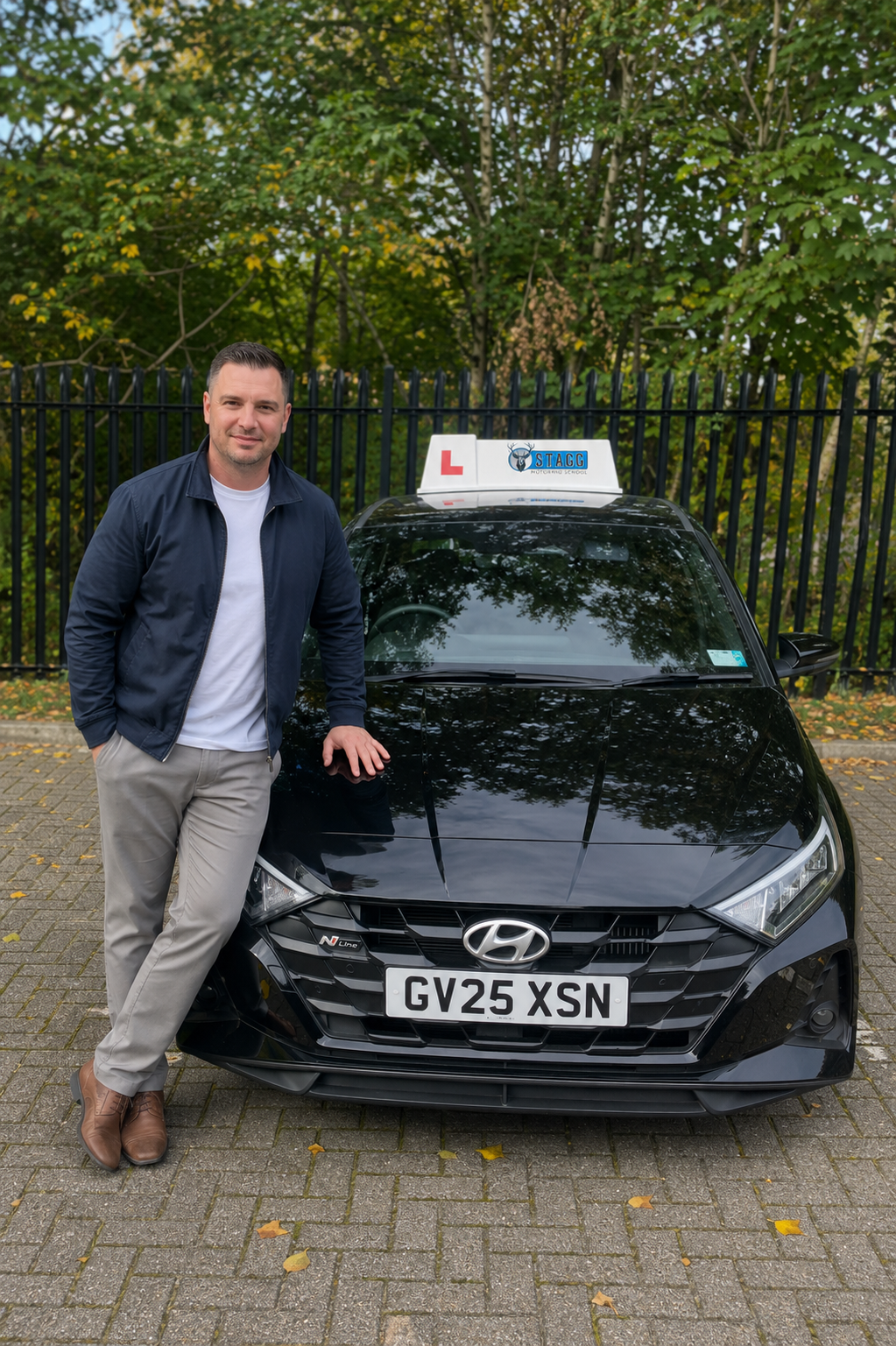
After 18 years of teaching in Crawley and Horsham, Dan Stagg has a clear picture of which elements genuinely cause the most difficulty — and crucially, why. Here's his breakdown of the hardest parts of the test and what you can do about each one.
1. The independent driving section
Since 2017, the driving test has included approximately 20 minutes of independent driving — following directions from a TomTom sat nav provided by the DVSA, or occasionally following road signs.
This is widely considered the hardest part of the modern test for one simple reason: you're no longer following an instructor's prompts. You're making all the decisions. The examiner is silent. The sat nav gives directions — but you have to judge speed, lane position, mirrors, and timing entirely yourself.
Why learners struggle:
- Fixating on the sat nav screen instead of the road
- Panicking when the sat nav says "turn left" at a junction you're approaching at speed
- Missing a turning and not knowing how to handle it calmly
- Forgetting to check mirrors because the nav demands attention
What helps:
- Extensive sat nav practice in lessons — not just occasional use
- Learning that missing a turning is not a fail — the sat nav recalculates, and you simply follow the new route
- Practising routes in the test area so the roads feel familiar even under nav guidance
"Missing a sat nav turning is not a fault. The examiner knows the nav recalculates. What matters is how you respond — calmly, safely, without braking sharply or changing lane suddenly. I build sat nav driving into lessons from the mid-point onwards so pupils are genuinely comfortable with it by test day."
2. Complex junctions and roundabouts
Junction observation is the number one cause of test failures nationally — not because learners don't know they need to look, but because they haven't had enough practice on genuinely difficult junctions to make the observation thorough and confident.
At Crawley DVSA Test Centre, the test routes include some of the most demanding junctions in the South East:
- roundabout — large, multi-lane, fast-moving traffic
- Hazlewick roundabout — complex lane discipline with multiple exits
- A23 dual carriageway — joining and leaving at speed, overtaking
- Crawley town centre junctions — traffic lights, box junctions, pedestrians
For learners in Crawley, the 36% first-time pass rate is largely explained by these roads. They're not impossible — but they require specific preparation, not just general driving practice. Read our Crawley driving lessons page for more on how Dan structures test-route preparation in this area.
Horsham learners face an additional challenge: they test at Crawley DVSA Test Centre, so they need to be equally familiar with Crawley's roads. See our Horsham driving lessons page for how this is handled.
3. Managing test nerves
Test anxiety affects almost every learner to some degree. For some, it's a mild flutter that sharpens focus. For others, it's a wave of panic that disrupts the driving they've spent months practising.
The most honest thing Dan can tell learners is this: nerves are not the problem. Unpreparedness is the problem. Nerves are amplified by uncertainty — and uncertainty comes from not knowing what's coming.
What genuinely helps with test nerves:
- Thorough preparation on the test routes. If you've driven every road on the Crawley test route multiple times, the test stops being unknown. It becomes another drive you've done before — with an unfamiliar passenger.
- A full mock test. Not a "practice drive" — a proper mock test where the instructor stays silent and you drive the full route independently. The experience of performing under observation, with no prompts, is the closest you can get to the real thing.
- A good night's sleep and food beforehand. Physical preparation matters. Tired, hungry learners underperform.
- Remembering that one mistake doesn't end the test. Minor faults are survivable. What fails people is the reaction to a minor fault — the anxiety spiral that causes the next three.
"I ask how every pupil is feeling at the start of every lesson — not just before the test. If they're having an off day, we adjust. The test is the same. You can't do the test on someone's behalf, but you can make sure they arrive having done everything possible to be ready. After that, it's about trusting the preparation."
4. Manoeuvres
Manoeuvres are what most learners worry about most — but statistically, they cause fewer failures than junction observation or inappropriate speed. That said, they're still genuinely difficult for many learners.
The current test includes one of the following:
- Reverse parallel park
- Forward bay park (drive in, reverse out)
- Reverse bay park (reverse in, drive out)
- Pull up on the right and reverse
The challenge with manoeuvres isn't usually coordination — it's spatial awareness. Learners who don't have reliable reference points (specific visual cues that tell them where the car is relative to the kerb or bay lines) have to guess. Guessing produces inconsistent results.
Dan teaches every manoeuvre using a structured sequence: iPad briefing, guided practice, prompted practice, and independent practice. By test day, each manoeuvre should feel repeatable — not a gamble.
For specific guidance on kerb contact during manoeuvres, see our article on whether hitting the kerb is an instant fail.
5. The show me / tell me questions
The test begins with two vehicle safety questions — the "show me / tell me" section. One is asked before you move, one while driving. Many learners find these unexpectedly stressful because they're unpredictable.
The DVSA publishes the full list of show me / tell me questions and answers. There are no surprises — every question on the test is on this list. Learning them takes an hour or two. A fault here is avoidable with minimal preparation.
6. Maintaining awareness under observation
Something unusual happens when people know they're being watched: they become self-conscious about actions they'd normally perform automatically. Checking mirrors, signalling, positioning — things that feel habitual in lessons — suddenly require deliberate thought under test conditions.
This is why examiners specifically look for natural, unhurried mirror checks rather than obvious "head flicks" designed to be seen. Learners who practise mirror checking as a reflex — not a performance for the examiner — demonstrate genuine safety habits rather than test technique.
The cure for self-consciousness under observation is simply more experience driving without prompts. This is why the mock test is so valuable — it builds the specific skill of driving independently under observation, which is different from driving well in lessons.
7. Driving in adverse conditions or unfamiliar situations
Most tests are conducted in normal conditions — but occasionally learners face rain, low sun, or unusually heavy traffic on test day. The ability to adapt to conditions is assessed throughout the test and is directly tied to the 5 C's of safe driving — particularly Caution and Common Sense.
Learners who have only ever practised in ideal conditions struggle when conditions change. Dan specifically includes lessons in rain, heavier traffic, and on unfamiliar roads to ensure pupils can adapt, not just perform a known routine.
For more on what the test is assessing broadly, read our guide on the 5 C's of safe driving.
What makes Crawley particularly hard
Crawley's 36% first-time pass rate isn't random. The town's road layout — a mix of fast dual carriageways, complex roundabouts, rural stretches, and dense town-centre traffic — creates a genuinely demanding test environment.
Learners who have only practised in quieter areas, or who have had lessons that avoid the challenging roads, arrive at the test unprepared. Those who have specifically trained on the Crawley test routes — including Hazlewick, the A23, and the town centre — arrive ready.
If you're preparing for your test in this area, see our areas we serve page for details on how Stagg Motoring School builds every lesson around the roads that matter.
Frequently asked questions
What is the hardest part of the driving test?
For most learners, the independent driving section is the most demanding — it requires sustained concentration without any prompts for around 20 minutes. Complex junctions and managing nerves are close behind.
What is the most failed part of the driving test?
According to DVSA data, ineffective observation at junctions causes more failures than any other single fault. Most learners expect manoeuvres to be the biggest challenge — but junctions cause more failures.
How do I stop being nervous on my driving test?
Thorough preparation on the actual test routes is the most effective approach. Familiarity removes the unknown, and the unknown is what amplifies anxiety. A full mock test under real conditions is also invaluable.
Is the driving test harder than it used to be?
The 2017 changes — longer independent driving, sat nav use, and revised manoeuvres — made the test more representative of real-world driving. Many instructors would argue this makes it fairer, not harder, because it tests genuine driving ability rather than a scripted performance.